Strategy · Article
Habit Stacking: Attach Money Habits to a Life You Already Live.
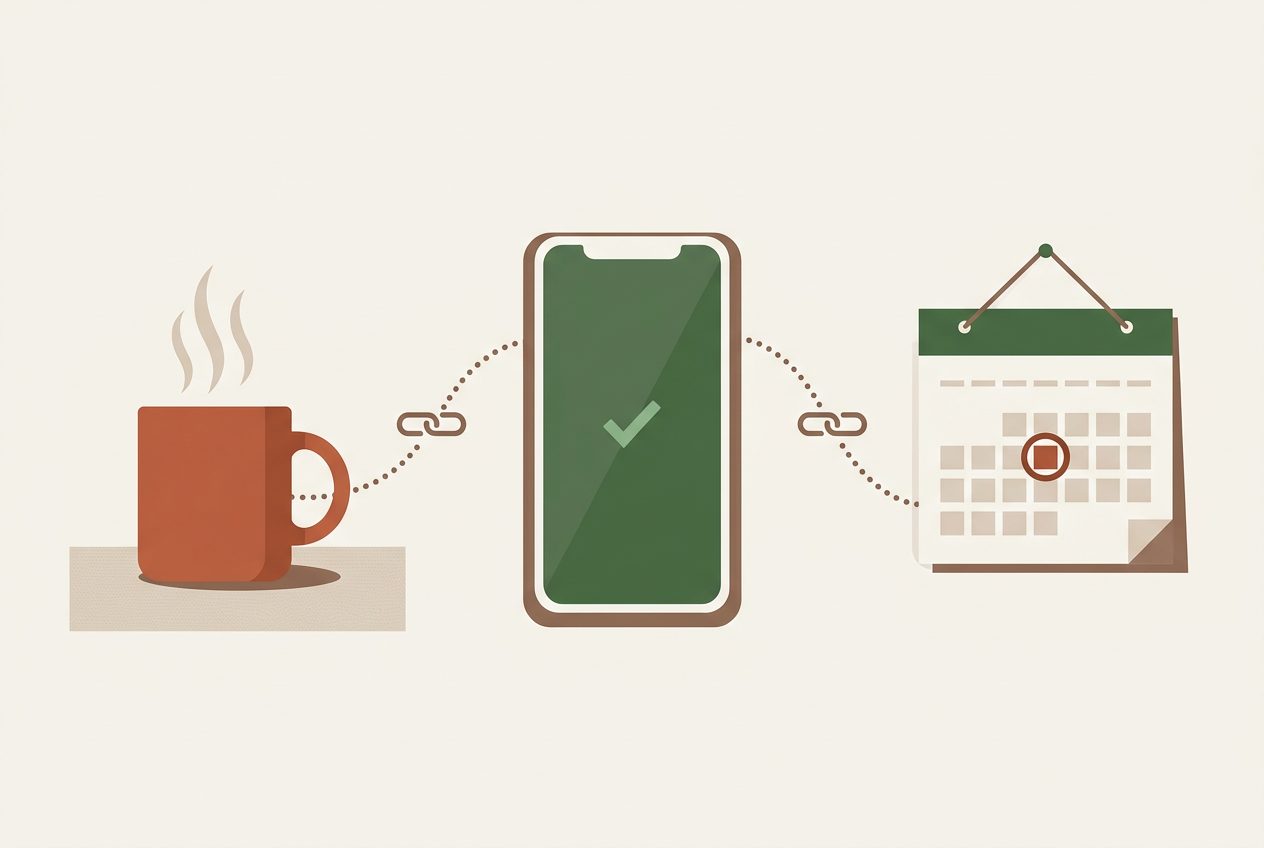
The coffee is poured. The phone is already in your hand. That whole sequence ran itself — you didn't decide any of it. That's why habit stacking for money can feel so doable when other money changes don't stick.
Most of us aren't looking for one more routine to manage. We're already moving through a full day on autopilot in more places than we notice, and a common pattern is that nearly half the day runs on habits. Instead of building from zero, we can borrow one of those existing rhythms and let a small money action ride along.
The idea
What habit stacking for money is and where it comes from.
Habit stacking for money takes a routine we already do and attaches a tiny financial action to it. BJ Fogg's Tiny Habits research at Stanford focused on anchor habits, which are existing behaviors that can hold a new one in place. James Clear later helped popularize the term habit stacking in Atomic Habits, and the core idea is refreshingly practical.
After I [habit I already do], I will [small money habit].
That's the whole move. We aren't asking life to slow down first. We're using anchor habits that already happen, which makes money habit stacking feel less like a big reset and more like a clean add-on to a life that's already in motion.
The mechanics
Why habit stacking for money works — the pre-installed cue.
Inside the Habit Loop, the order is cue, routine, reward, then review. In the Strategy series, that's the backbone because the cue is often the hardest part to create (see: the Habit Loop paper). If the cue never fires, the routine doesn't happen, even when the intention is real.
Habit stacking for money solves that by borrowing a cue that's already alive in the day. The coffee gets poured. The alarm gets silenced. Payday lands. We're not building a fresh loop from scratch — we're splicing into one that's already running, and that lowers friction in a big way.
That matters for households that have tried a Spending Plan before and drifted away from it. The issue often isn't effort. It's that the money task was floating with no trigger, no place to land, and no reward close enough to feel satisfying. A stack gives the habit a home.
Ready to run
Six ready-made habit stacking for money examples.
Stack 01
After I pour my first coffee or tea…
I glance at my Running Balance for 30 seconds. That's not a full review, and it doesn't need to be.
Reward: No surprises today.
Stack 02
After my paycheck lands…
I move savings first, before the day makes suggestions. This can be one transfer and done, and it's over in under a minute.
Reward: Progress happened before spending decisions crowded the screen.
Stack 03
After I silence my morning alarm…
I check the next bill on my Cash Flow Calendar. We're not scanning the whole month here, only the next item coming up.
Reward: Today's money picture feels clearer before the day speeds up.
Stack 04
After Sunday breakfast…
I scan the next 7 days of bills. This is a great time to notice timing, spot a pinch point, or confirm that the week is already covered.
Reward: Zero surprise Tuesdays.
Stack 05
After I pay any bill…
I check it off on the calendar. That tiny receipt ritual creates closure, and closure matters more than most people expect.
Reward: The receipt ritual, closure.
Stack 06
After I add anything to an online cart…
I leave it until tomorrow's coffee glance. That pause turns the purchase into a decision instead of a reflex, which can sharpen a Spending Plan without turning the day into a debate.
Reward: The purchase becomes a decision, not a reflex.
Fit it in
How to make these stacks part of your system.
The best money habit stacking examples are small enough that they don't ask for motivation on a busy day. A 30-second Running Balance glance works because it fits inside real life. A one-minute Cash Flow Calendar check works because it answers one question fast: what's next?
This is also why financial micro-habits tend to last longer than dramatic overhauls. When we attach habits to routines we already trust, we don't have to remember them from scratch. That's a calmer system for households with work, errands, texts, bills, and a hundred moving parts already competing for attention.
If we want a bigger picture around these small stacks, they also fit neatly inside a Spending Plan. The stack handles the action. The Spending Plan holds the overall map. And if we're building wealth over time, these tiny cues connect well with larger strategy moves too (see: 7 Money Pillars) and (see: Income Strategies to Build Wealth).
Pacing
The stack ladder — one at a time.
Run one stack for two weeks before adding the next. That gives the cue time to bond with the routine so it starts to happen with less effort and more consistency. Once the first stack feels automatic, then we can stack a new habit on top of another anchor.
Trying five at once usually backfires, even when the plan looks smart on paper. Stacking five habits at once is just a budget wearing a disguise. When the first stack runs without much thinking, add the second, and let the system grow one rung at a time.
This is the Ready approach in real life: fewer ideas, more repetition. We don't need a dramatic reset to change a money pattern. We need one clean sequence that keeps happening.
The three ways habit stacks fail
- Anchor too vague: "after work" can slide around, but "after I plug in my phone" is clear and repeatable.
- Routine too big: anything over 2 minutes starts acting like a project, not a habit, and projects ask for more energy than a stack can carry.
- No reward: name the payoff out loud — clarity, closure, or a number that grew — because the reward helps the loop want to repeat.
Obstacles deserve a plan too, and the research calls it an if/then plan. Before the obstacle shows up, decide the response in advance: "If payday lands while I'm away from home, then I do my Running Balance glance from my phone before breakfast." The if names the moment that usually breaks the stack — a late shift, a road trip, a week that gets loud. The then names the smallest version of the habit that still counts. A stack with an if/then plan doesn't need a perfect week to survive; it just needs a decided one.
Put it together
Your first stack, written out.
After I pour my first coffee, I will glance at my Running Balance because it gives me a day with no surprises.
The rule of the stack: the anchor stays exactly as it is. You change nothing about your life — you attach one small thing to it.
In closing
You already have the routines. Stacking gives them a second job.
That's often enough to move money forward without adding strain. If you're ready to build that system into a bigger strategy, register for Financial Habits to Succeed and start your loop. If you're not ready to commit yet, the free MoneyMind Quiz can help you find your MoneyMind Archetype and the rhythm that fits how your household already works.
Ready to run your first stack?
Start free — cancel anytime. Private by default.