Strategy · Article
The Wealth Formula: How Habit Loops Turn Small Actions Into Lifelong Growth.
Wealth has always looked mysterious from the outside. Some people seem to accumulate it effortlessly, while others work just as hard and never feel like they're getting ahead. Strip away the noise and the truth is plainer: wealth isn't built through luck, secret knowledge, or sudden breakthroughs. It's built through behavior — specifically, through habits that compound over time.
The math
The formula everyone knows — and why it isn't enough.
Wealth = (Income − Expenses) + (Assets − Liabilities)
That's the clean, mathematical version, and it matters. Income minus expenses becomes savings. Savings invested become assets. Assets minus liabilities equal net worth. But this formula only describes the result. It doesn't explain the process — how to behave daily, weekly, and monthly in a way that steadily moves the number. It also can't explain why two households with the same income end up in wildly different places.
For that, we need a behavioral formula:
Wealth = (Quality Decisions × Time × Consistency) + Compounding − Friction
Quality decisions are the right habits. Time lets compounding do the heavy lifting. Consistency means repeating the behavior long enough to matter. And friction — debt, impulse spending, chaos — is the force quietly subtracting from all of it. Even this version, though, is incomplete without one more layer: the engine that produces consistency in the first place. Habit loops.
The engine
The Habit Loop Wealth Formula.
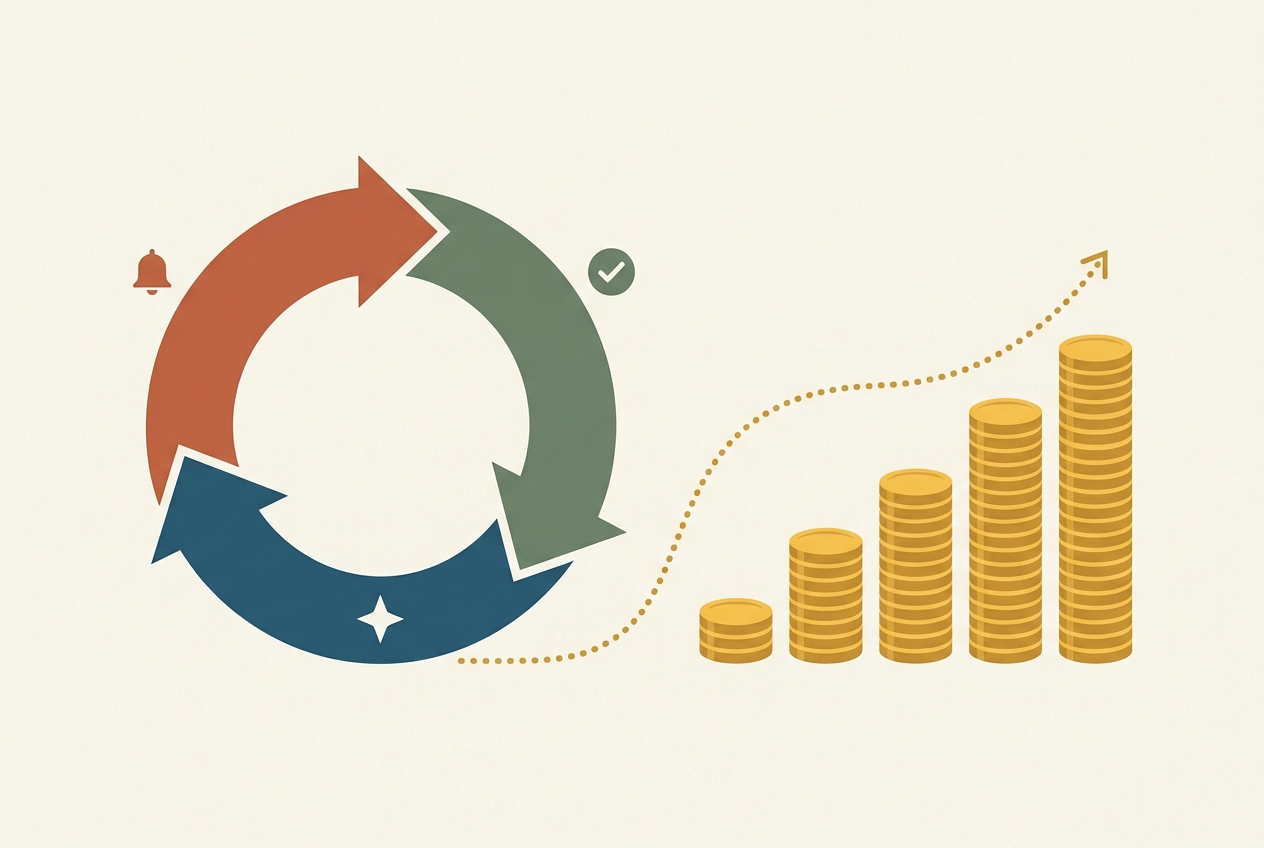
Every habit loop has three parts — cue, routine, reward (the backbone of the Habit Loop paper). Apply those parts to money and the formula becomes:
Wealth = (Cue → Routine → Reward), repeated consistently, multiplied by compounding.
Simple — but not easy, because most people never design their loops intentionally. They rely on motivation, willpower, or vague intentions. Motivation is unreliable. Willpower is inconsistent. Intentions fade. Habit loops don't: once installed, they run automatically and turn financial growth into a pattern instead of a struggle.
Cue
The trigger that says "do the thing now." Random cues — checking the account only when something goes wrong — create reactive money behavior. Intentional cues tied to daily life (payday, morning coffee, Sunday night) create proactive behavior. The cue is the ignition switch; without it, the routine never starts.
Routine
The action that builds wealth: moving money to savings, updating the Running Balance, reviewing subscriptions, paying down debt, checking the dashboard. A routine done once changes nothing. A routine done weekly changes everything.
Reward
The feeling that makes it stick: the satisfaction of a balance growing, the relief of bills covered, the calm of seeing 30 days ahead. When the reward is meaningful, the loop locks in. When it's missing, the loop dies. This is why a weekly check-in is so powerful — reflection is a built-in reward.
In action
Three loops, written out.
Loop 01
Cue
Payday lands
Routine
Move 10% to savings first, then update the Running Balance
Reward
Watch the 30-day projection improve on the spot
Repeat this loop every payday for two months and the behavior changes. Six months and the identity changes. Two years and the net worth changes.
Loop 02
Cue
Sunday evening
Routine
A five-minute weekly check-in on the Cash Flow Calendar
Reward
A sense of control and clarity heading into the week
This loop builds awareness, awareness leads to better decisions, and better decisions lead to better outcomes.
Loop 03
Cue
The urge to impulse buy
Routine
Open the Spending Plan and look at what that money is already assigned to
Reward
Regain control and skip the regret
This loop attacks friction directly — the part of the formula that subtracts from progress.
The comparison
Why habit loops beat motivation, every time.
This is why the wealth formula has to be behavioral. Relying on motivation to save, invest, or plan means doing it inconsistently — and consistency is the multiplier in the formula. For six ready-made loops that borrow cues already alive in your day, see Habit Stacking.
The multiplier
Compounding: the force that multiplies your habits.
Compounding is the part of the formula that turns small habits into large outcomes. Save $200 a month and that's $2,400 a year in contributions. Invest that same $200 a month at a 7% average annual return — roughly the long-run historical average for a diversified stock portfolio — and the balance grows to about:
Year 1
~$2,500
$2,400 of it yours
Year 5
~$14,000
$12,000 of it yours
Year 15
~$63,000
$36,000 of it yours
By year fifteen, contributions total $36,000 — the other ~$27,000 is compounding doing its quiet work. And it only works when the habit is consistent. This is why the loop matters more than the amount: a small habit repeated consistently beats a large habit repeated inconsistently.
Figures are illustrative, based on a 7% average annual return compounded monthly. Markets vary year to year and returns are never guaranteed. This article is education, not financial advice.
The subtraction
Friction: the force that subtracts.
Friction is anything that slows or reverses progress:
- Debt carried without a paydown plan
- Impulse and emotional spending
- Missed payments and late fees
- Disorganization — money with no map
- Lifestyle creep as income rises
Habit loops reduce friction automatically. A "when a bill arrives, log it on the calendar immediately" loop prevents missed payments. A "when stress hits, open the dashboard" loop replaces emotional spending with clarity. Friction is the silent killer of wealth — loops are the antidote. The 7 Money Pillars cover the bigger structural moves that shrink friction for good.
Build yours
How to build your own wealth habit loop.
- 1
Choose one financial habit to build.
Saving, tracking, reflecting, paying down debt — one, not five.
- 2
Define a clear cue.
Tie it to something that already happens: payday, morning coffee, Sunday dinner.
- 3
Keep the routine small.
Small enough to run on your worst day. Under two minutes is the sweet spot.
- 4
Name the reward.
Clarity, closure, a number that grew. Say it out loud — the reward is what makes the loop repeat.
- 5
Repeat weekly.
Consistency is the multiplier in the formula. A small habit done weekly beats a big one done twice.
- 6
Reflect every Sunday.
Reflection is reinforcement. It is also where the loop gets adjusted instead of abandoned.
- 7
Stack the next loop only when the first runs itself.
One habit at a time. Always.
In closing
When the loops run the system, wealth stops being something you chase.
Cues fire automatically. Routines run automatically. Rewards reinforce automatically. Compounding multiplies quietly in the background, and friction shrinks a little every week. That's the behavioral foundation of lifelong wealth — and it starts with one loop, not ten. If you're not sure which loop fits how you're wired, the free MoneyMind Quiz points you to a starting habit matched to your money personality.
Ready to install your first loop?
Start free — cancel anytime. Private by default.